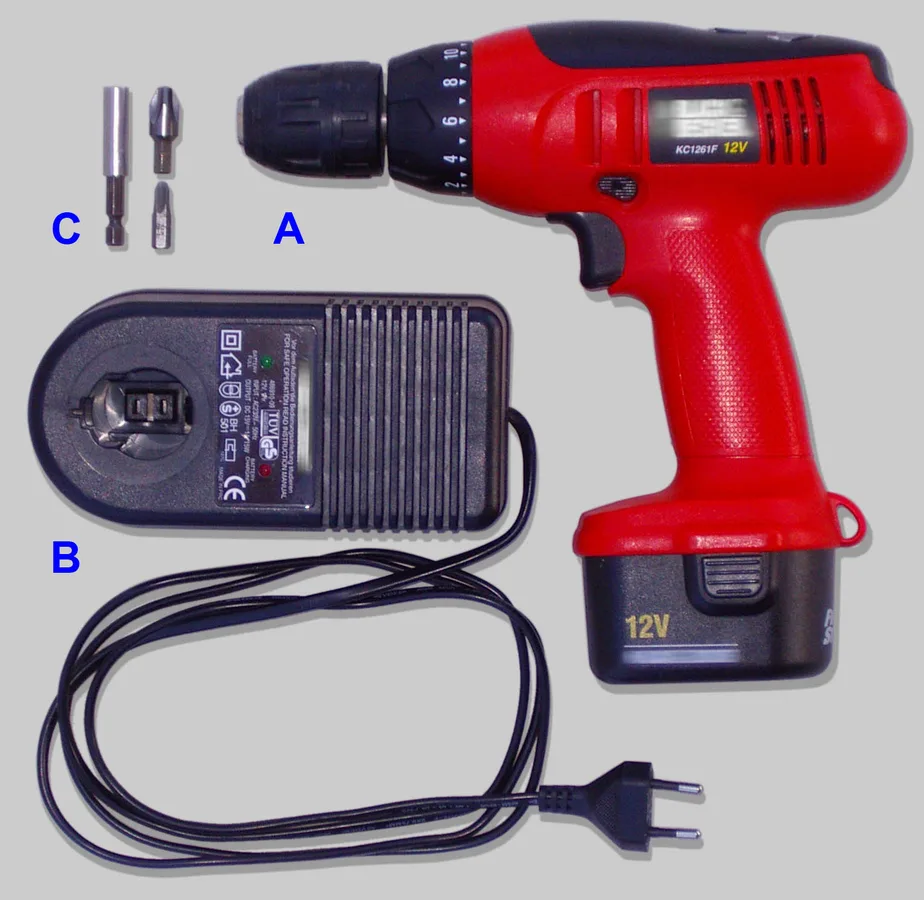
Drill or impact driver? Decide from the bit and the job.
A chuck and a hex holder solve different accessory questions. Make the job specific before buying a second tool.
Start with the next project rather than the tool silhouette. Are you making holes, driving a particular screw, or alternating between the two? Write down the material, hole or fastener specification, accessory shank and available working space. This turns “Which is better?” into a question you can check against the tool and accessory instructions. It also prevents an attractive second tool from duplicating a task your current one already supports.
Look at the connection first. Makita XPH14Z is a hammer driver-drill with a 1/2 in ratcheting chuck; XDT19Z is an impact driver with a 1/4 in hex holder. They share the 18V LXT platform but do not accept accessories in the same way. Check both the shank and the accessory’s intended tool use, including any restrictions in the manual. The Milwaukee impact-driver instructions, for example, call for specifically recommended accessories.
For a shortlist centered on drilling, begin with the chuck-equipped candidates and the supported drilling application. For a shortlist centered on a screwdriving task, compare the exact driver controls and accessory requirements rather than assuming every impact tool is equivalent. A drill/driver can also drive fasteners, and the Milwaukee impact-driver manual allows suitable drill and driver bits. These overlapping uses are why the accessory and task matter more than a rigid rule that one tool can only drill and the other can only drive.
Keep the platform constant when judging a second purchase. An existing LXT owner can compare XPH14Z with XDT19Z. An existing M12 owner can compare Milwaukee 3404-20’s 1/2 in metal chuck with 3453-20’s 1/4 in hex holder. These examples keep the battery family visible while you investigate the difference in capability. They do not establish that every pack in the wider brand range is supported or that either product is the best choice for every owner.
Compare the kind of fastening control, too. Milwaukee specifies a mechanical clutch on 3404-20 and four-mode Drive Control on 3453-20. Those are different control arrangements, so a count of settings alone does not make them equivalent. For an assembly where fastener seating matters, read the relevant operating procedure and decide which arrangement meets that need before buying. This guide does not assign either control system a measured torque accuracy.
Separate that tool decision from the package decision. All four example model numbers here are tool-only records without included batteries and chargers. If you are beginning the LXT platform, XPH14T is a distinct drill kit to investigate; it is not an impact-driver kit. Check the accessory list separately, too. A belt clip, bag or included battery does not tell you whether the correct bit for your project is in the box.
Save one candidate per role, then review the specific manual pages for the operation you intend to perform. If your existing tool already supports the job, identify the remaining limitation: accessory changeover, controls, access or a missing capability. Buy around that limitation. Tool Drip’s examples come from manufacturer references; this guide does not claim measured speed, comfort or durability from hands-on testing.
Sources for this article
Makita XPH14Z tool and supported platformMakita XDT19Z hex impact driverMilwaukee 3404-20 M12 hammer drill/driverMilwaukee 3453-20 M12 hex impact driverMilwaukee 2953-20 accessory and operating instructionsMakita XPH14T exact kit contentsUse current manufacturer references for final specifications and compatibility. This is buying context, not an installation manual or a claim of hands-on testing.